The Hyperreality of Nahdlatul Ulama on Social Media: Dynamics of Ulama Representation, the Labelling of Religious Traditions, and Challenges to Religious Authority
DOI:
https://doi.org/10.35672/jnus.v7i2.129-141Keywords:
Nahdlatul Ulama, Hyperreality, Digital Discourse, Religious AuthorityAbstract
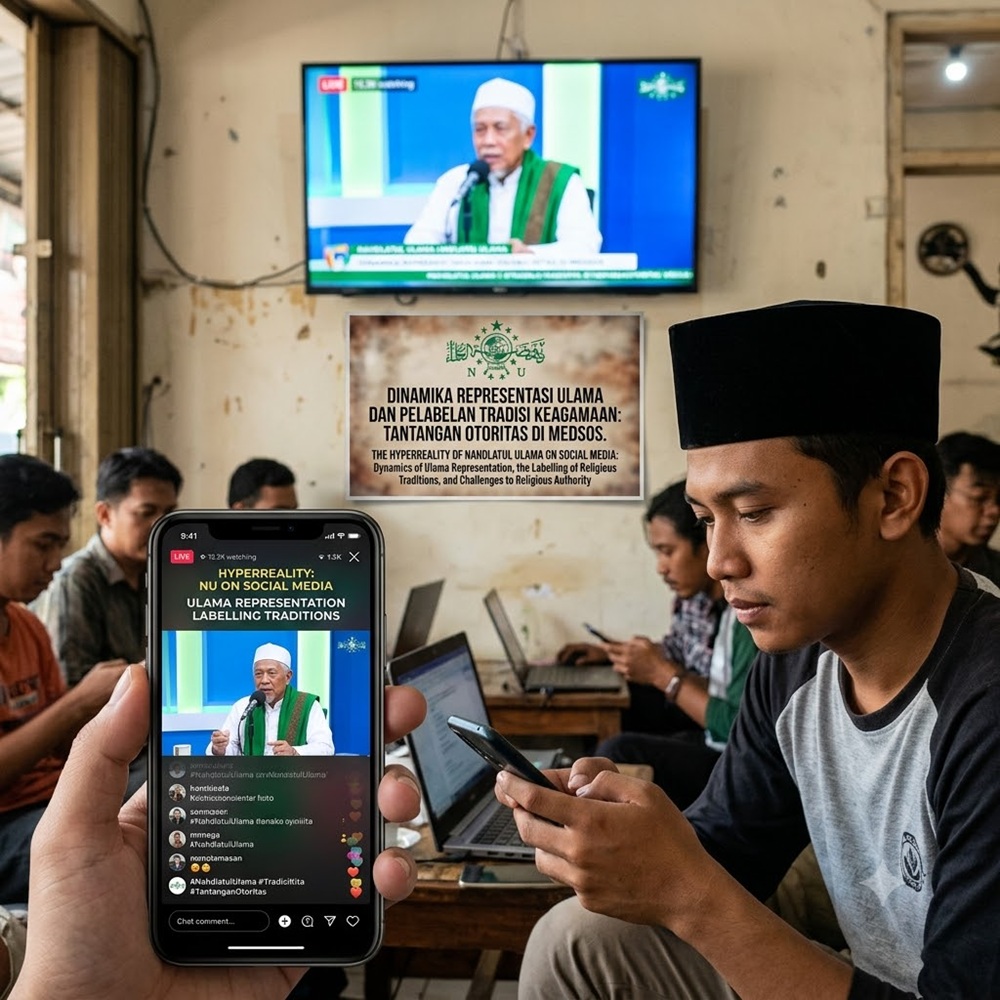
Social media has given rise to new forms of religious identity representation that often differ from the actual reality. Nahdlatul Ulama (NU), as the largest Islamic organization in Indonesia, has undergone an image transformation through digital content that is often satirical in nature, such as the comedic portrayal of clerics, the characterization of the sholawat tradition as concert entertainment, and memes that parody NU symbols. This study aims to examine how power relations and discourse in the digital space shape the hyperreality of NU’s identity, as well as how this influences the position of its religious authority. The research method employed is qualitative, utilizing a critical discourse analysis approach to viral social media content, supported by in-depth observation and literature review. Using the netnography method, primary data was collected from content and interactions on three Instagram accounts: @guss_icikk, @pixmenleonard, and @andripul_, while secondary data was obtained from scholarly literature on religious discourse and digital media. The analysis was conducted by utilizing Michel Foucault’s concepts of discourse, knowledge-power, and regimes of truth, combined with Jean Baudrillard’s idea of hyperreality. The research findings indicate that the negative image of NU is formed through the production of digital discourse that emphasizes humor and performativity to serve the logic of virality. Content creators act as new agents of power who reframe NU’s symbols and traditions, while netizens affirm these labels through comments that reproduce stereotypes. This process gives rise to a new regime of truth in cyberspace, where the hyperreal image of NU is more trusted by the public than its traditional reality. Consequently, NU’s traditional religious authority rooted in scholarly lineage and the charisma of religious leaders is being displaced by a digital authority grounded in popularity and online user engagement. This study underscores the importance of digital literacy and discourse strategies for NU in negotiating its religious identity and authority in the era of social media.
References
Amin, M., Javanmard, K., & Sharbatian, Y. (2024). The Role of Modern Social Media on the Representation of Religion among Teenage Girls. Bi-Quarterly Scientific Journal of “Religion & Communication,” 31(2). https://doi.org/10.30497/rc.2024.245886.2032
Aslam, S. (2025). Pergeseran Otoritas Keagamaan Di Era Media Sosial: Tantangan Otentisitas Tafsir Dalam Konten Digital. ISME : Journal of Islamic Studies and Multidisciplinary Research, 3(2), 92–99. https://doi.org/10.61683/isme.vol32.2025.92-99
Ejue, O. G., & Etim, D. S. (2024). Post-Truth Society and the Social Media in The 21st Century. Creative Artist: A Journal of Theatre & Media Studies, 18(1), 75.
Faisal, & Abdullah, Y. (2025). Komunikasi Ulama Di Era Viral (Studi Representasi Gus Miftah dan Narasi Religius di Media Digital). PRESIDENSI: Jurnal Politik Dan Pemerintahan, 2(2), 74–98. https://doi.org/10.64019/presidensi.v2i2.69
Hoesterey, J. B. (2021). Nahdlatul Ulama’s “Funny Brigade”: Piety, Satire, and Indonesian Online Divides. CyberOrient, 15(1), 85–118. https://doi.org/10.1002/cyo2.8
Juliandini, F. D., Khuzaimah, Aulia, S., Zahra, S. A., & Faqihuddin, A. (2025). Dinamika Seni dan Hiburan dalam Islam: Studi tentang Persepsi Ulama dan Mahasiswa terhadap Sholawat Aransemen di Indonesia. Advances In Education Journal, 2(1), 73–82.
Khasanah, S. U. (2022). Nahdlatul Ulama Da’wah Dynamics: Socio-Cultural Change and Disruption. KOMUNIKA: Jurnal Dakwah Dan Komunikasi, 16(2), 183–199. https://doi.org/10.24090/komunika.v16i2.6810
Le, H. (2020). Blasé Attitude, Hyperreality, and Social Media. Crossing Borders: Student Reflections on Global Social Issues, 2(1). https://doi.org/10.31542/cb.v2i1.1990
Leitch, S., & Merlot, E. (2018). Power relations within brand management: The challenge of social media. Journal of Brand Management, 25(2), 85–92. https://doi.org/10.1057/s41262-017-0081-1
Lillqvist, E., Louhiala-Salminen, L., & Kankaanranta, A. (2016). Power relations in social media discourse: Dialogization and monologization on corporate Facebook pages. Discourse, Context & Media, 12, 68–76. https://doi.org/10.1016/j.dcm.2015.11.001
Masyitoh, R., & Majid, M. N. (2024). Dakwah Influencer: Analisis Konten Dakwah Neng Umi Laila di Media Sosial. J-KIs: Jurnal Komunikasi Islam, 5(2), 335–350. https://doi.org/10.53429/j-kis.v5i2.1183
Mibtadin, R. (2022). Nahdatul Ulama, Religious Traditions, and Rural Communities: Narrative of Shifting Religious Traditions of the People of Bangunrejo Kidul Village, East Java. Journal of Hunan University Natural Sciences, 49(9). https://jonuns.com/index.php/journal/article/view/1187
Mutakin, A. (2018). Kitab Kuning dan Tradisi Intelektual Nahdlatul Ulama (NU) dalam Penentuan Hukum (Menelisik Tradisi Riset Kitab Kuning). Syariah: Jurnal Hukum Dan Pemikiran, 18(2), 192–210. https://doi.org/10.18592/sy.v18i2.2270
Nurhamidin, B., Mokodenseho, S., Mokodompit, H., Bahansubu, A., & Rumondor, P. (2025). Transformasi Otoritas Keagamaan di Era Digital, Analisis Sosiologis terhadap Pergeseran Pola Otoritas Ulama di Media Sosial. Journal of Educational and Religious Perspectives, 1(1), 39–48.
Prasetyo, A., Misbahuddin, M., & Sari, D. Y. (2025). Etika Dakwah Dalam Polemik Gus Miftah dan Penjual Es Teh: Analisis Perspektif Moral dan Sosial. Hikmah, 19(2), 275–292. https://doi.org/10.24952/hik.v19i2.17057
Pratama, M. Y., & Annuha, A. N. (2024). Digital Da’wah Transformation of Nahdlatul Ulama: Religious Moderation Strategies in the Technological Era. NAHNU: Journal of Nahdlatul Ulama and Contemporary Islamic Studies, 2(2), 321–338. https://doi.org/10.63875/nahnu.v2i2.53
Rafiansyah, M. F. (2023). The Influence of Dakwah Using Memes on Instagram Social Media on The Faith of Islamic Netizens in Indonesia. Indonesian Journal of Islamic Communication, 6(1), 109–124. https://doi.org/10.35719/ijic.v6i1.1960
Roslan, M. H., Zahari, S. Z. M., & Ghani, M. Z. A. (2025). Da’wah on the Social Media: The Youth Engagement in Digital Islamic Content. International Journal of Research and Innovation in Social Science (IJRISS), IX(1). https://dx.doi.org/10.47772/IJRISS.2025.9010098
Syafiuddin, A. (2018). Pengaruh Kekuasaan Atas Pengetahuan (Memahami Teori Relasi Kuasa Michel Foucault). Refleksi Jurnal Filsafat Dan Pemikiran Islam, 18(2), 141–155. https://doi.org/10.14421/ref.v18i2.1863
Syuhudi, I., Zen, M., & Fatmawati -. (2024). Optimalisasi Manajemen Dakwah Pada Era Digital Oleh Lembaga Dakwah Pengurus Besar Nahdatul Ulama. Tadbir: Jurnal Manajemen Dakwah FDIK IAIN Padangsidimpuan, 6(1), 1–18.
Tanoyo, M. (2024). Apakah Kebenaran Selalu Benar? Memahami Filosofi Kebenaran Dalam Ajaran Plato dan Michel Foucault. Journal of Syntax Literate, 9(8), 4055. https://doi.org/10.36418/syntax-literate.v9i8.16011
Van Dijck, J., & Poell, T. (2013). Understanding Social Media Logic (SSRN Scholarly Paper No. 2309065). Social Science Research Network. https://papers.ssrn.com/abstract=2309065
Van Kessel, C., Manriquez, J. D., & Kline, K. (2025). Baudrillard, hyperreality, and the ‘problematic’ of (mis/dis)information in social media. Theory & Research in Social Education, 53(2), 249–271. https://doi.org/10.1080/00933104.2024.2439302
Wolny, R. W. (2017). Hyperreality and Simulacrum: Jean Baudrillard and European Postmodernism. European Journal of Interdisciplinary Studies Articles, 3. https://doi.org/10.26417/ejis.v8i1.p76-80
Yusuf, M. Z., Nahar, M. H., Abror, H. M., & Renaldi, M. H. (2024). Digital Strategies for Promoting Religious Moderation: The Role of Muhammadiyah and Nahdlatul Ulama on Social Media. International Journal of Nusantara Islam, 12(2), 116–130. https://doi.org/10.15575/ijni.v12i2.40448
Zaid, B., Fedtke, J., Shin, D. D., El Kadoussi, A., & Ibahrine, M. (2022). Digital Islam and Muslim Millennials: How Social Media Influencers Reimagine Religious Authority and Islamic Practices. Religions, 13(4), 335. https://doi.org/10.3390/rel13040335
Zuhri, A. M. (2021). Beragama di Ruang Digital; Konfigurasi ideologi dan Ekspresi Keberagamaan Masyarakat Virtual. Nawa Litera Publishing.
Downloads
Published
How to Cite
Issue
Section
License
Copyright (c) 2026 Ibnu Akbar Maliki, Darmawansa, Wahyu Kristianto

This work is licensed under a Creative Commons Attribution-ShareAlike 4.0 International License.




.png)


