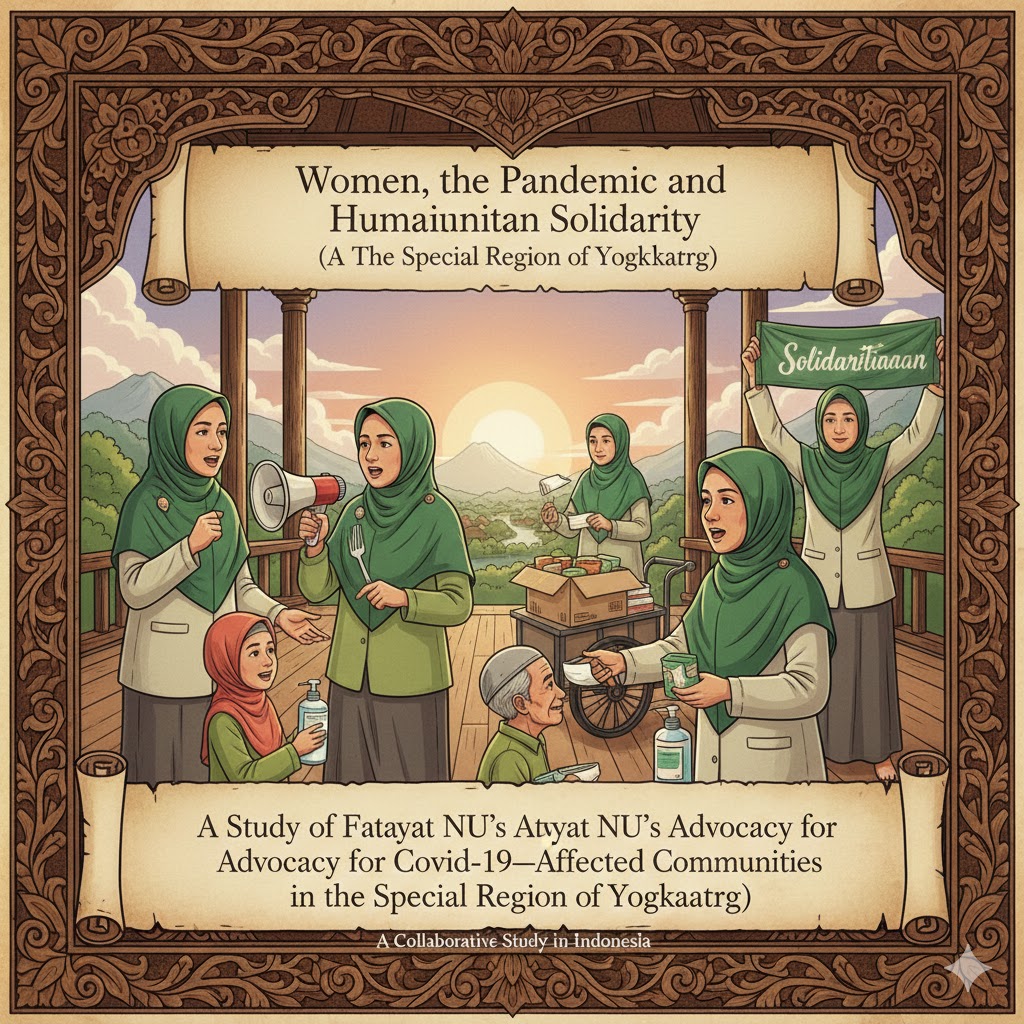
Women, the Pandemic, and Humanitarian Solidarity (A Study of Fatayat NU’s Advocacy for Covid-19–Affected Communities in the Special Region of Yogyakarta)
DOI:
https://doi.org/10.35672/jnus.v6i2.143-156Keywords:
Women, Covid-19 Pandemic, Humanitarian Solidarity, Advocacy, Fatayat NU DIY, Women’s MovementAbstract
The Covid-19 pandemic and social restriction policies (PSBB/PPKM) have reshaped everyday life and generated wide-ranging socio-economic impacts. Women have experienced layered vulnerabilities from increased unpaid care work and loss of livelihoods to rising domestic violence and heightened family precarity. Against this backdrop, this article poses two questions: (1) how did Fatayat NU DIY’s advocacy strategies build humanitarian solidarity for communities affected by Covid-19 in the Special Region of Yogyakarta; and (2) what were the impacts of this advocacy particularly for women and what enabling and constraining factors shaped its implementation? This study adopts a qualitative approach using a case-study design focused on PW Fatayat NU DIY, drawing on interviews with organizational leaders and volunteers, analysis of organizational documents and program records, and observations of advocacy practices during the pandemic. The findings show that Fatayat NU DIY implemented advocacy through a combination of emergency response and recovery initiatives: distribution of basic necessities, support for healthcare workers, assistance for pesantren clusters, public communication to prevent and counter misinformation, corpse care volunteers and vaccination support through GARFA, and recovery programs such as support for self-isolating patients, MSME assistance, family and domestic-violence consultation services through LKP3A, parenting programs, trauma healing, and food security initiatives. These efforts strengthened social protection and the resilience of women’s communities, although they were constrained by mobility restrictions, pervasive hoaxes and public resistance, and household economic pressures. The study recommends strengthening vulnerability mapping and beneficiary databases, developing crisis-response SOPs, expanding referral networks for women’s protection services, intensifying anti-misinformation digital literacy, and sustaining economic recovery programs through simple monitoring and evaluation mechanisms.
References
Amelia, K. and Zahara, C. R. (eds.) (n.d.) Antisipasi Resesi dan Krisis Pangan Akibat Pandemi. Aceh: Syiah Kuala University Press.
Arivia, G. (2020) ‘Feminist Perspectives: Intersectionality and Covid-19’, Jurnal Perempuan, 25(4), no. 107 (November).
Azizah, N. and Lubis, M. A. (eds.) (n.d.) Fenomena Masyarakat di Era Pandemi Covid-19. Indramayu: Penerbit Adab.
Fauziah, A. S. N., Fauzi, A. N. and Ainayah, U. (2020) ‘An Analysis of the Rising Divorce Rate During the Covid-19 Period’, Mizan: Journal of Islamic Law, 4(2).
Fatayat DIY (n.d.) ‘Born in Yogyakarta, Garda Fatayat has now become a national organisational structure’. Available at: https://fatayatdiy.com/news/lahir-di-diy-kini-garda-fatayat-menjadi-struktur-kelembagaan-yang-sifatnya-nasional/ (Accessed: 28 January 2026).
Fatayat NU (n.d.) ‘History’. Available at: https://fatayatnu.or.id/sejarah/ (Accessed: 28 January 2026).
Husna, K., Fithriati, M. and Munawaroh, S. (2019) Buku Saku GARFA. Yogyakarta: Badan Pengembangan Organisasi, Pendidikan dan Pengkaderan PW Fatayat NU DIY.
Indonesia (1984) Law of the Republic of Indonesia No. 4 of 1984 on Communicable Disease Outbreaks.
Indonesia (2007) Law of the Republic of Indonesia No. 24 of 2007 on Disaster Management.
Indonesia (2020a) Presidential Decree of the Republic of Indonesia No. 7 of 2020 on the Covid-19 Task Force for Accelerated Response.
Indonesia (2020b) Presidential Decree of the Republic of Indonesia No. 9 of 2020 on Amendments to Presidential Decree No. 7 of 2020 on the Covid-19 Task Force for Accelerated Response.
Kominfo (n.d.) ‘Kominfo: By June, 850 Covid-19–related hoaxes had been identified’. Available at: https://www.kominfo.go.id/content/detail/27755/kominfo-hingga-juni-terdapat-850-hoaks-terkait-covid-19/0/sorotan_media (Accessed: 28 January 2026).
Majelis Ulama Indonesia (MUI) (2020a) MUI Fatwa No. 14 of 2020 on the Implementation of Worship in the Context of the Covid-19 Outbreak.
Majelis Ulama Indonesia (MUI) (2020b) MUI Fatwa No. 28 of 2020 on Guidelines for Takbir and Eid al-Fitr Prayer During the Covid-19 Pandemic.
Majelis Ulama Indonesia (MUI) (2020c) MUI Fatwa No. 31 of 2020 on Friday Prayer and Congregational Worship to Prevent Covid-19 Transmission.
Majelis Ulama Indonesia (MUI) (2022) Kep-28-III-2022: Statement of the MUI Leadership on MUI Fatwas Related to Worship During the Pandemic (10 March 2022). Available at: https://mui.or.id/wp-content/uploads/2022/03/Kep-28-III-2022-Bayan-Dewan-Pimpinan-MUI-Tentang-Fatwa-MUI-terkait-Pelaksanaan-Ibadah-dalam-Masa-Pandemi-10-Maret-2022.pdf (Accessed: 28 January 2026).
Tim Penulis PW Fatayat NU DIY (2002) Gerakan Perempuan Islam Moderat: Sejarah Pimpinan Wilayah Fatayat Nahdhatul Ulama Daerah Istimewa Yogyakarta. Yogyakarta: Ladang Kata and PW Fatayat NU DIY.
Tristanto, A. (2020) ‘Divorce During the Covid-19 Pandemic in a Social Science Perspective’, Jurnal Sosio Informa, 6(3).
Interview with Fetra Nur Hikmah (Provincial Coordinator of GARFA DIY), 10 July 2022.
Interview with Khotimatul Husna (Chair of PW Fatayat NU DIY), 21 July 2022.
Downloads
Published
How to Cite
Issue
Section
License
Copyright (c) 2026 Zunly Nadia

This work is licensed under a Creative Commons Attribution-ShareAlike 4.0 International License.




.png)


