
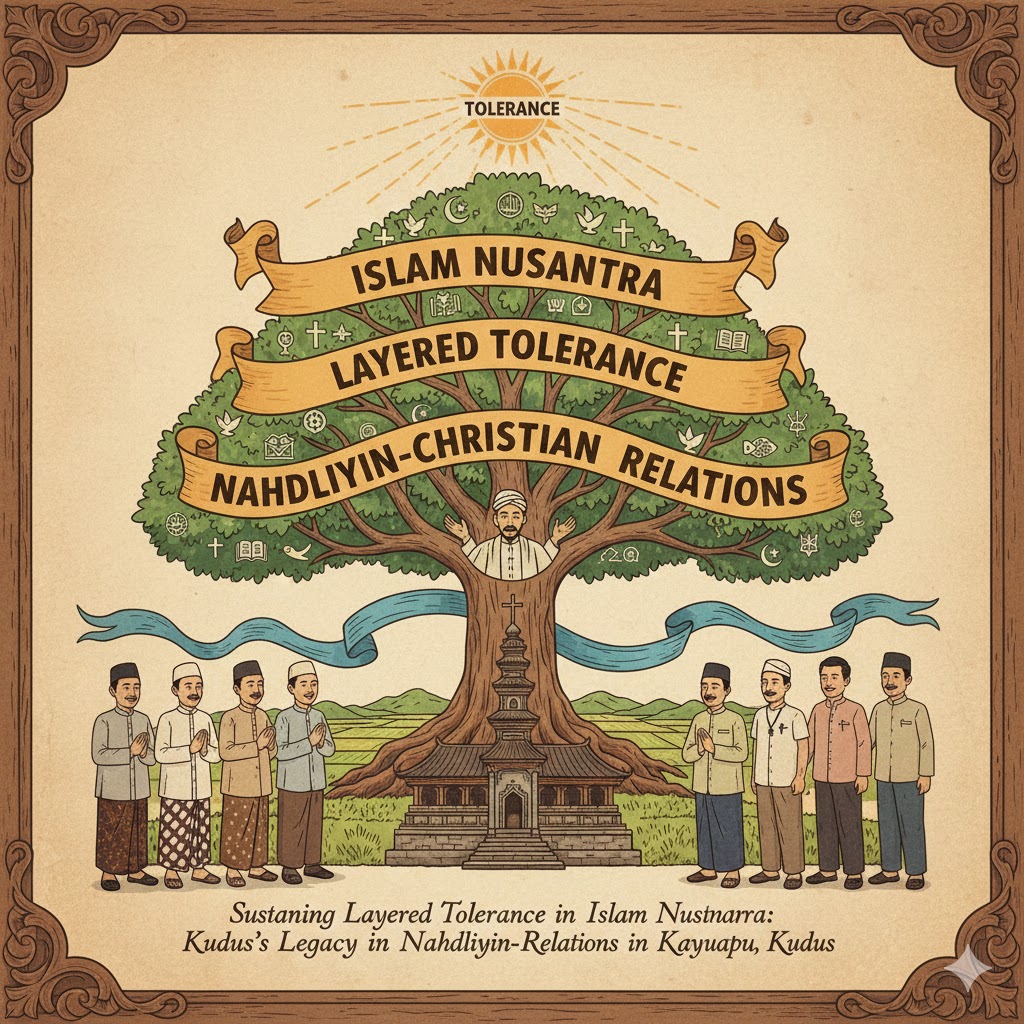
Sustaining Layered Tolerance in Islam Nusantara: Sunan Kudus’s Legacy in Nahdliyin–Christian Relations in Kayuapu, Kudus
DOI:
https://doi.org/10.35672/jnus.v6i2.114-129Keywords:
Sunan Kudus, Nahdliyin (NU), Layered Tolerance, Muslim–Christian Relations, Contact Zone, Aswaja TraditionsAbstract
Islam–Christian relations at the village level are often shaped by a long history of coexistence, yet they remain vulnerable to identity anxiety, conversion concerns, and symbolic competition. In the context of Kudus, the legacy of Sunan Kudus commonly narrated as accommodative da‘wah and an ethic of respect toward other groups can function as cultural capital that stabilizes interfaith encounters. This article aims to explain how the historical context of colonialism, the development of zending/missionary activities and Islamic preaching, and the collective memory of Walisongo Islamization (particularly Sunan Kudus) have shaped patterns of Islam–Christian relations in Dukuh Kayuapu, as well as how Nahdliyin residents practice “layered tolerance” through NU/Aswaja cultural strategies (tahlil, berjanjen/shalawat, pengajian, and TPQ) within this contact zone. The study adopts a qualitative approach with a case study design in Dukuh Kayuapu, Gondangmanis Village, Bae Subdistrict, Kudus; data were collected through limited participant observation, semi-structured interviews with purposively selected informants (NU figures, cross-generational residents, church council/pastor, and village officials), and document analysis, and were analyzed thematically. The findings show that tolerance in Kayuapu operates as a governance of difference: social harmony is maintained through everyday contact (neighborly interaction, bereavement solidarity, and collective work), while theological boundaries are selectively managed through relatively subtle boundary maintenance. Aswaja traditions function as a “protective infrastructure” that strengthens internal cohesion and reduces conversion anxiety without provoking open conflict, while the legacy of Sunan Kudus serves as cultural legitimation for an ethic of interfaith respect. The study recommends strengthening cross-community humanitarian social-contact spaces, formulating mutually agreed codes of encounter for sensitive issues, reinforcing moderate religious literacy within each community, and activating the narrative of Sunan Kudus’s legacy as a public moral language to prevent the escalation of friction in interfaith contact zones.
References
Allport, G.W. (1954) The Nature of Prejudice. Cambridge, MA: Addison-Wesley.
Architecture Heritage (n.d.) ‘Benteng Marlborough (Sejarah)’. Benteng Indonesia. Available at: online (Accessed: 29 January 2026).
Berger, P.L. (1967) The Sacred Canopy: Elements of a Sociological Theory of Religion. New York: Anchor Books.
Braun, V. and Clarke, V. (2006) ‘Using thematic analysis in psychology’, Qualitative Research in Psychology, 3(2), pp. 77–101.
Benda, H.J. (1958) Bulan Sabit dan Matahari Terbit: Islam Indonesia pada Masa Pendudukan Jepang. Jakarta: Pustaka Jaya.
Creswell, J.W. and Poth, C.N. (2018) Qualitative Inquiry & Research Design: Choosing Among Five Approaches. 4th edn. Thousand Oaks, CA: SAGE.
Detik (2023) ‘Sejarah Masjid Menara Kudus, Simbol Akulturasi Budaya dan Keunikannya’. Detik Jateng. Available at: online (Accessed: 29 January 2026).
GAMEO (n.d.) ‘Gereja Injili di Tanah Jawa (GITJ)’. Global Anabaptist Mennonite Encyclopedia Online. Available at: online (Accessed: 29 January 2026).
Geertz, C. (1976) The Religion of Java. Chicago: University of Chicago Press.
Historia.id (2015) ‘Toleransi Beragama ala Sunan Kudus’. Historia.id. Available at: online (Accessed: 29 January 2026).
Kumaat, M. (1973) Benih yang Tumbuh: Gereja Injili di Tanah Jawa. Jakarta: Lemlit dan Studi Dewan Gereja-Gereja di Indonesia.
Lamont, M. and Molnár, V. (2002) ‘The Study of Boundaries in the Social Sciences’, Annual Review of Sociology, 28, pp. 167–195.
Metro TV (2025) ‘Masjid Menara Kudus Cerminan Toleransi’. Metrotvnews.com. Available at: online (Accessed: 29 January 2026).
Murianews (2023) ‘Mengenal Sejarah Gereja Kayuapu Kudus yang Berusia 170 Tahun’. Murianews.com. Available at: online (Accessed: 29 January 2026).
NU Online Jateng (2024) ‘Sunan Kudus dan Larangan Penyembelihan Sapi sebagai Kurban’. NU Online Jawa Tengah. Available at: online (Accessed: 29 January 2026).
Pettigrew, T.F. and Tropp, L.R. (2006) ‘A Meta-Analytic Test of Intergroup Contact Theory’, Journal of Personality and Social Psychology, 90(5), pp. 751–783.
Putnam, R.D. (2000) Bowling Alone: The Collapse and Revival of American Community. New York: Simon & Schuster.
Rosyid, M. and Kushidayati, L. (2026) ‘Kontribusi Sunan Kudus yang Diwarisi Nahdliyin dalam Mewujudkan Toleransi’. Unpublished manuscript, IAIN Kudus.
Shiraisi, T. (2005) Zaman Bergerak: Radikalisme Rakyat di Jawa 1912–1926. Jakarta: Pustaka Grafiti.
Sinode GITJ (n.d.) ‘Sejarah Sinode GITJ’. Sinode GITJ. Available at: online (Accessed: 29 January 2026).
Sukoco and Yoder, L.M. (2010) Tata Injil di Bumi Muria. Semarang: Pustaka Muria.
UIN FAS Bengkulu (2018) ‘Objek Wisata Sejarah Benteng Marlborough’ (PDF). E-journal UIN FAS Bengkulu. Available at: online (Accessed: 29 January 2026).
UIN Sunan Kalijaga (2020) ‘Sunan Kudus: Anjuran Tidak Menyembelih Sapi sebagai Bentuk Toleransi’. Sosiologi Agama UIN Suka. Available at: online (Accessed: 29 January 2026).
UMK (2016) ‘Pesan Toleransi dalam Tradisi Kurban di Kudus’. Universitas Muria Kudus. Available at: online (Accessed: 29 January 2026).
Yin, R.K. (2018) Case Study Research and Applications: Design and Methods. 6th edn. Thousand Oaks, CA: SAGE.
Downloads
Published
How to Cite
Issue
Section
License
Copyright (c) 2026 Moh Rosyid, Lina Kushidayati

This work is licensed under a Creative Commons Attribution-ShareAlike 4.0 International License.




.png)


