
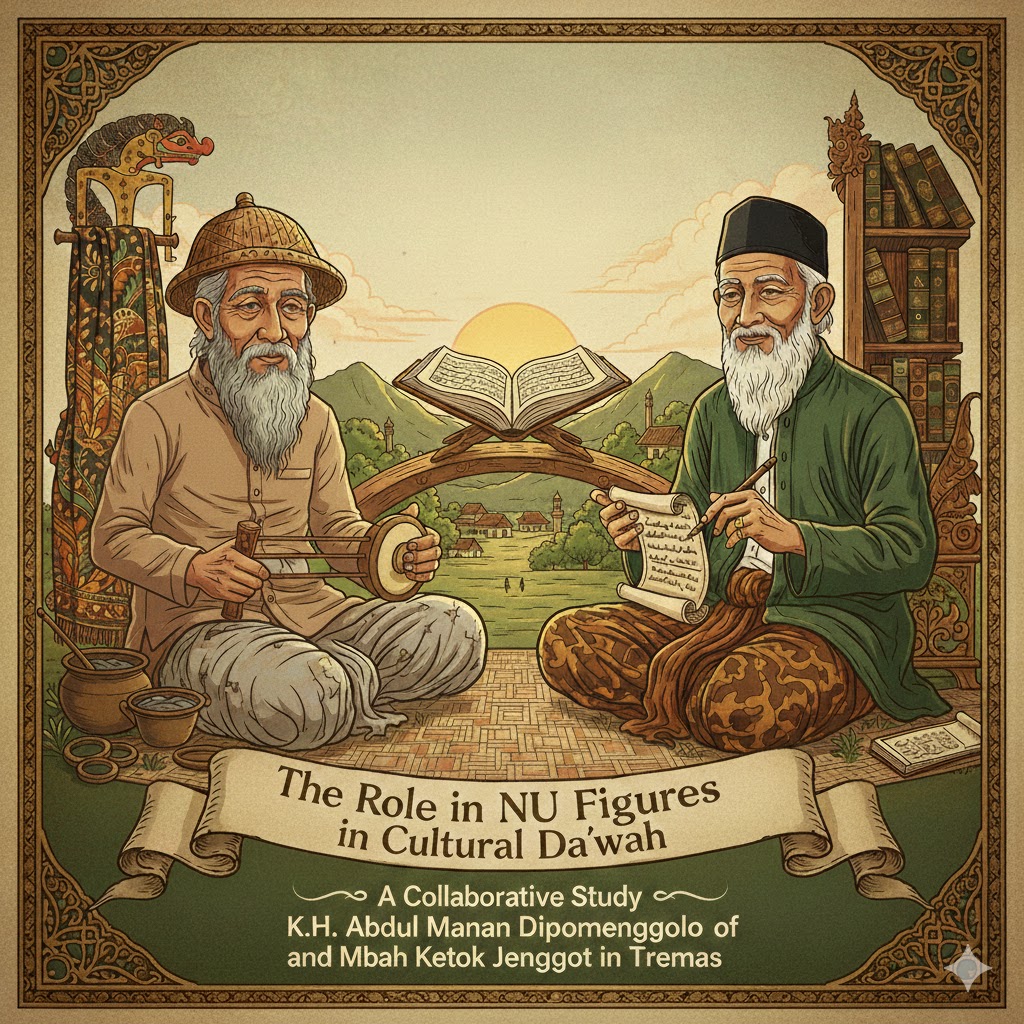
The Role of NU Figures in Cultural Da‘wah: A Collaborative Study of K.H. Abdul Manan Dipomenggolo and Mbah Ketok Jenggot in Tremas
DOI:
https://doi.org/10.35672/jnus.v6i2.99-113Keywords:
Da‘wah Collaboration, Babat Alas, Tremas, K.H. Abdul Manan, Mbah Ketok JenggotAbstract
Cultural da‘wah in Java has frequently advanced through negotiated encounters between Islamic teachings and local socio-cultural systems. In Tremas (Pacitan), the historical narratives of land clearing (babat alas) and the subsequent emergence of pesantren leadership illustrate how spiritual authority and social legitimacy can jointly shape community Islamization across different periods. This study addresses two questions: (1) How does cultural da‘wah through acculturation, indigenization, and cultural mediation explain the roles and legitimacy of local figures (Mbah Ketok Jenggot and K.H. Abdul Manan Dipomenggolo) in fostering the acceptance of Islam in Tremas? (2) How does the pesantren as an educational da‘wah institution—via religious habitus formation, cadre reproduction, and scholarly networks explain K.H. Abdul Manan’s strategies in institutionalizing Islam sustainably in Tremas? Employing a qualitative descriptive design, the study draws on documentary data from Manuskrip Tremas (Ahmad Muhammad) and semi-structured interviews with key local custodians (the hamlet head and the site caretaker). Data were collected through systematic reading–note-taking and interviews, then analyzed using an interactive model (data reduction, display, and conclusion drawing). The findings indicate that Mbah Ketok Jenggot functions as a cultural mediator whose land-clearing narratives and symbolic authority provide early socio-cultural legitimacy, enabling Islam to enter local meaning systems gradually. K.H. Abdul Manan’s da‘wah is consolidated through the establishment of mosque-based learning and pesantren infrastructure that stabilizes religious practice, produces disciplined religious habitus, and sustains transmission through educational routines and expanding scholarly lineages. The study recommends strengthening local historical-literacy documentation as a cultural da‘wah resource, structuring pesantren-based cadre formation for continuity, and expanding inter-pesantren/NU networks for broader educational impact. Future research should deepen triangulation across archives, multi-informant narratives, and long-term ethnographic observation to refine understanding of cultural mediation processes.
References
Ahmad Muhammad (2019) Manuskrip Tremas. Surakarta: Phoenix.
Ahmadi, Al. (2023) ‘Kisah Kethok Jenggot, Pendiri Desa Tremas Pacitan Yang Sakti Madraguna’, Ketik.co, 2023.
Anwar Sanusi (2023) ‘Sejarah Pondok Tremas Pacitan, Penerima Anugerah Pesantren Tua Dari PBNU’, Jatim.Nu.or.Id, 2023.
Creswell, J.W. (2009) Research Design. 3rd edn. SAGE. https://doi.org/10.1163/22118993-90000268.
Faizin/Mahbib, Z. (2014) ‘KH Abdul Manan Dipomenggolo, Pionir Jaringan Ulama Nusantara’, Nu.or.Id, 2014.
Firdhayanti (2020) ‘Metodologi Penelitian’, Repository.Upi.Edu.
Fitriatul Mahmudah (2017) Sistem Pendidikan Salafiyah sebagai Nilai Keunggulan Kompetitif (Studi Kasus di Perguruan Islam Pondok Tremas Pacitan). IAIN Ponorogo.
Herlianto A. (2021) ‘Sejarah Desa Tremas Pacitan, Tempat Lahir Presiden RI Ke 6’, Tugujatim.Id, 2021.
Intan Wijayanti (2016) Kepemimpinan Kolektif dalam Pengambilan Kebijakan (Studi Kasus di Perguruan Islam Pondok Tremas Pacitan). IAIN Ponorogo.
Miles, M.B. and Huberman, A.M. (1994) Qualitative Data Analysis. 2nd edn. California: Sage.
Moleong, L.J. (2006) ‘Metode Penelitian’, Radenfatah.Ac.Id, pp. 1–23. Available at: https://repository.radenfatah.ac.id/19077/3/3.pdf.
Muhammad Imron (2017) ‘Sejarah Berdirinya Pondok Pesantren TREMAS, Pacitan Jawa Timur’, Kuwaluhan.Com, 2017.
Muhdhori Ahmad (2022) ‘Sejarah Ketok Jenggot Sang Babat Desa Tremas’, Mahadaly-Attarmasi, 2022.
Rojihan (2021) ‘Cerita Kesaktian Mbah Kethok Jenggot, Sang Babat Alas Desa Tremas Pacitan’, Times Indonesia, 2021.
Wiyonggo Seto (2015) ‘Babad Termas (Sejarah Pesantren Termas Pacitan)’, Wiyonggoputih.Co, 2015.
Azra, A. (2004) The Origins of Islamic Reformism in Southeast Asia: Networks of Malay–Indonesian and Middle Eastern ‘Ulama’ in the Seventeenth and Eighteenth Centuries. Honolulu: University of Hawai‘i Press.
Bourdieu, P. (1990) The Logic of Practice. Cambridge: Polity Press.
Dhofier, Z. (1994) Tradisi Pesantren: Studi tentang Pandangan Hidup Kyai. Jakarta: LP3ES.
Geertz, C. (1960) The Religion of Java. Chicago: University of Chicago Press.
Hefner, R.W. (2000) Civil Islam: Muslims and Democratization in Indonesia. Princeton: Princeton University Press.
Koentjaraningrat (1985) Javanese Culture. Singapore: Oxford University Press.
Lave, J. and Wenger, E. (1991) Situated Learning: Legitimate Peripheral Participation. Cambridge: Cambridge University Press.
Ricklefs, M.C. (2006) Mystic Synthesis in Java: A History of Islamization from the Fourteenth to the Early Nineteenth Centuries. Norwalk: EastBridge.
Steenbrink, K.A. (1986) Pesantren, Madrasah, Sekolah: Pendidikan Islam dalam Kurun Modern. Jakarta: LP3ES.
van Bruinessen, M. (1994) Kitab Kuning, Pesantren dan Tarekat: Tradisi-tradisi Islam di Indonesia. Bandung: Mizan.
Wahid, A. (2001) Pergulatan Negara, Agama, dan Kebudayaan. Jakarta: Desantara.
Woodward, M.R. (1989) Islam in Java: Normative Piety and Mysticism in the Sultanate of Yogyakarta. Tucson: University of Arizona Press.
Downloads
Published
How to Cite
Issue
Section
License
Copyright (c) 2026 Afra Sabrina Mumtaz, Fadhilah Nur Ramadhani Yumna, Munirotuz Zahro Wardati, Mohammad Fajriyanto, Muhammad Rizal Kurniawan

This work is licensed under a Creative Commons Attribution-ShareAlike 4.0 International License.




.png)


