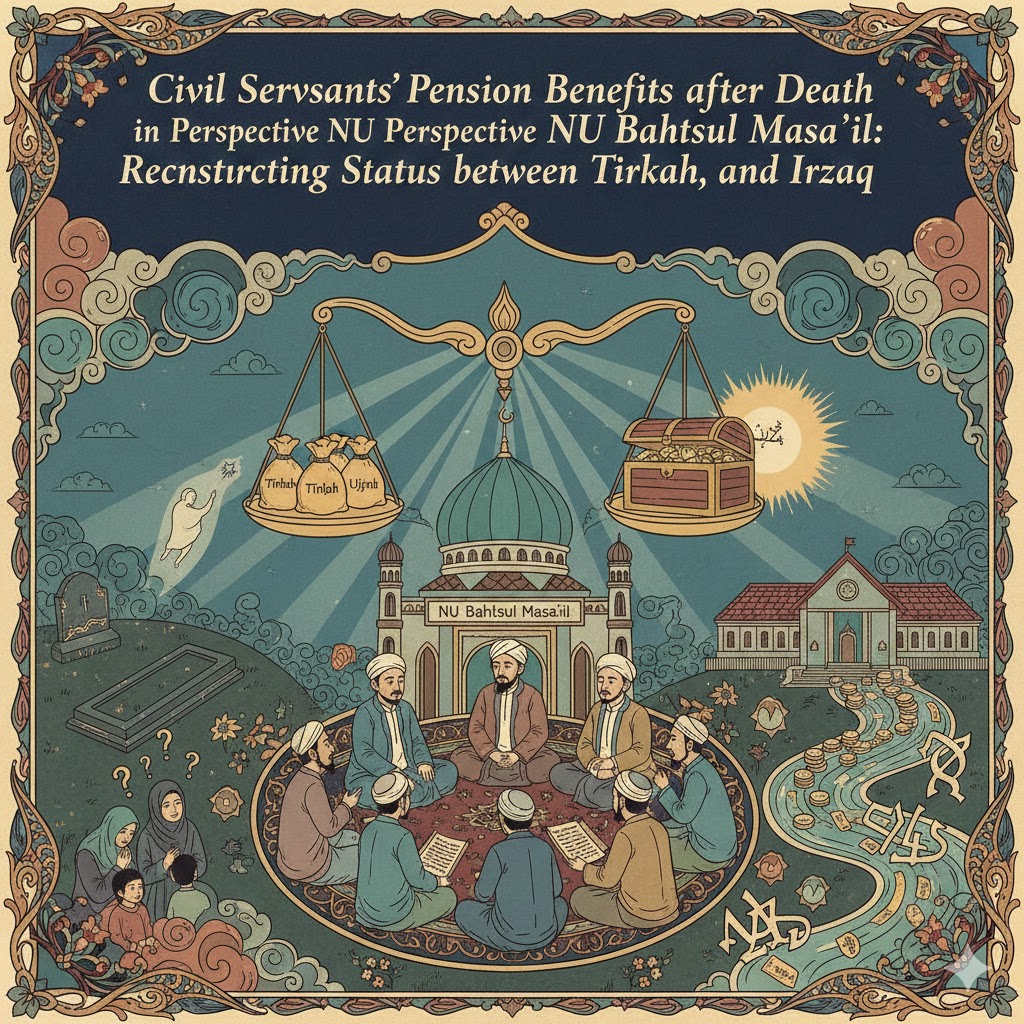
Civil Servants’ Pension Benefits after Death in the Perspective of NU Bahtsul Masa’il: Reconstructing Status between Tirkah, Ujrah, and Irzaq
DOI:
https://doi.org/10.35672/jnus.v6i2.86-98Keywords:
Inheritance, Pension Benefits, Civil Servants (PNS), Tirkah, Ujrah, Irzāq, Bahtsul Masa’il NUAbstract
The death of a civil servant (Pegawai Negeri Sipil, PNS) often triggers family disputes regarding the legal status of pension benefits: whether they constitute tirkah (the deceased’s estate) that must be distributed according to farā’iḍ (Islamic rules of inheritance), or whether they are entitlements designated for specific recipients under state regulations. This divergence in understanding may lead to intra-family conflict, particularly when pension benefits are perceived as “the fruits of one’s labor” and thus assumed to be distributable as inheritance, even though the state pension scheme for widows/widowers/children is conditional and its beneficiaries are predetermined. Against this background, the study formulates two questions: (1) what is the status of a PNS pension after death according to the NU (Nahdlatul Ulama) Bahtsul Masa’il does it fall under tirkah or should it be regarded as irzāq; and (2) what are the legal bases and methods of istinbāṭ employed by Bahtsul Masa’il NU in determining the status of PNS pensions within the conceptual distinction between tirkah, ujrah, and irzāq/rizq. This research adopts a qualitative approach through library research using a descriptive analytical method, drawing on documentary analysis of Bahtsul Masa’il NU decisions, classical and contemporary literature on Islamic inheritance law and uṣūl al-fiqh, as well as statutory regulations governing PNS pensions. The analysis proceeds deductively by deriving general inheritance principles and definitions of tirkah, and then testing them against the characteristics of pensions as conditional benefit entitlements whose beneficiaries are determined by regulation. The findings show that Bahtsul Masa’il NU classifies PNS pension benefits particularly widow/widower/child pensions as not part of tirkah and therefore not subject to inheritance distribution; rather, they are positioned as irzāq/rizq (a grant/social provision) that becomes the right of designated recipients in accordance with applicable provisions. NU’s method of istinbāṭ is reflected in its consistent adherence to the four Sunni legal schools, reliance on aqwāl al-mujtahidīn and authoritative fiqh references, and its firm delineation of tirkah as property already owned by the deceased prior to death. The study recommends coordinated dissemination to PNS families and relevant institutions (government offices, religious counsellors, the Office of Religious Affairs/KUA, and fatwa bodies) on the distinction between tirkah and pension entitlements to minimize disputes, as well as the development of practical guidelines grounded in fiqh and statutory regulations to help the public differentiate inherited assets from pension benefit rights.
References
al-Bukhari, M.I. (1979) Ṣaḥīḥ al-Bukhārī. Ed. M.F. Muhibuddin al-Khotib. Cairo: Maṭba‘ah al-Salafiyyah.
al-Bukhari, M.I. (1990) Ṣaḥīḥ al-Bukhārī. Beirut: Dār al-Fikr, Vol. 4.
al-Ghazali, A.H.M.M. (n.d.) Iḥyā’ ‘Ulūm al-Dīn. Cairo: Maṭba‘ah al-Miṣr, Vol. 2.
al-Haitami, A.M.H. (n.d.) Al-Fatāwā al-Kubrā al-Fiqhiyyah. Beirut: Dār al-Fikr, Vol. 6.
al-Jurjani, A.M. (2009) At-Ta‘rīfāt. Beirut: Dār al-Kutub al-‘Ilmiyyah.
al-Mawardi, A.H.A. (n.d.) Al-Ḥāwī al-Kabīr fī Fiqh al-Shāfi‘ī. Beirut: Dār al-Fikr, Vol. 8.
al-Nawawi, Y.S. (n.d.) Al-Majmū‘ Sharḥ al-Muhadhdhab. Beirut: Dār al-Fikr, Vol. 3.
al-Qalyubi, S. and ‘Umairah, A. (2005) Ḥāshiyah al-Qalyūbī wa ‘Umairah. Beirut: Dār al-Fikr, Vol. 3.
al-Qalyubi, S. and al-Burlusi ‘Umairah, A. (n.d.) Ḥāshiyah al-Qalyūbī wa ‘Umairah. Cairo: Dār al-Kutub, Vol. 3.
as-Shawy, A.M. (n.d.) I‘ānat al-Ṭālibīn. Beirut: Dār al-Ḥadīth, Vol. 3.
Basyir, A.A. (n.d.) Hukum Waris Islam. [tanpa data lengkap penerbit/kota].
Hadi, S. (1990) Metodologi Research. Yogyakarta: Andi Offset.
Hasil Sidang Majelis Tarjih Muhammadiyah (2008) Pembagian Warisan. Disidangkan pada Jum’at, 19 Rabiul Akhir 1429 H / 25 April 2008 M. [tanpa data penerbit].
Jamil, F. (1995) Metode Ijtihad Majlis Tarjih Muhammadiyah. Jakarta: Logos.
Lembaga Bahtsul Masail Jawa Tengah (2011) Putusan Bahtsul Masail NU Jawa Tengah. Kebumen, 30 Januari 2011. [dokumen putusan].
Lembaga Bahtsul Masail Jawa Tengah (2015) Keputusan/Putusan tentang Status Dana Pensiun PNS (bukan tirkah). Jawa Tengah: LBM NU Jateng. (Diakses 5 Maret 2015).
Manan, A. (2006) Aneka Masalah Hukum Perdata di Indonesia. Jakarta: Kencana.
Muhammad Muhyiddin ‘Abdul Hamid (n.d.) Aḥkām al-Mawārīth fī al-Sharī‘ah al-Islāmiyyah ‘alā Madhāhib al-Arba‘ah. [tanpa data lengkap penerbit/kota].
Muslih, U. (1997) Kaidah-kaidah Ushuliyah dan Fiqhiyah. Jakarta: RajaGrafindo Persada.
Prodjodikoro, W. (1983) Hukum Warisan di Indonesia. Bandung: Sumur Bandung.
Putusan Majelis Tarjih Muhammadiyah Pusat (2007) Pembagian Warisan. Disidangkan di Cirebon pada Jum’at, 13 Zulqa‘dah 1428 H / 23 November 2007 M.
Qur’an (n.d.) Al-Qur’an al-Karīm, Surah an-Nisā’ (4): 33.
Rajasa, S. (2002) Kamus Ilmiah Populer. Surabaya: Karya Utama.
Ramli. , s.i.s.m.b.a.a.b.h.b.s.a (2003) Nihāyat al-Muḥtāj ilā Sharḥ al-Minhāj. Cairo: Dār al-Kitāb al-‘Ilmiyyah, Vol. 4.
Ramulyo, M.I. (1992) Perbandingan Hukum Kewarisan Islam. Jakarta: CV Pedoman Ilmu Jaya.
Riyanta, R. (2012) ‘Kewarisan Beda Agama (Studi Pandangan Muaz bin Jabal)’, Asy-Syir’ah: Jurnal Ilmu Syari’ah dan Hukum, 46(1), pp. 1–20.
Said, I.G. and Asrori, A.M. (eds.) (2005) Ahkām al-Fuqahā’: Solusi Problematika Aktual Hukum Islam. Terj. Djamaluddin Miri. Surabaya: LTN NU dan Diantama.
ash-San‘ani, M.I. (1960) Subul al-Salām: Sharḥ Bulūgh al-Marām min Jam‘ Adillat al-Aḥkām. Cairo: Muṣṭafā al-Bābī al-Ḥalabī wa Awlādih, Vol. 3.
Syarifudin, A. (2004) Hukum Kewarisan Islam. Jakarta: Prenada Media.
Sutrisno (1990) [Rujukan tentang putusan Tarjih & Tajdid Muhammadiyah terkait pensiun/kemaslahatan].
Sutan Rajasa (2002) Kamus Ilmiah Populer. Surabaya: Karya Utama.
Republik Indonesia (1969) Undang-Undang Republik Indonesia Nomor 11 Tahun 1969 tentang Pensiun Pegawai dan Pensiun Janda/Duda Pegawai. Jakarta: Pemerintah Republik Indonesia.
Republik Indonesia (1974) Undang-Undang Republik Indonesia Nomor 8 Tahun 1974 tentang Pokok-Pokok Kepegawaian. Jakarta: Pemerintah Republik Indonesia.
Republik Indonesia (1999) Undang-Undang Republik Indonesia Nomor 43 Tahun 1999 tentang Perubahan atas Undang-Undang Nomor 8 Tahun 1974 tentang Pokok-Pokok Kepegawaian. Jakarta: Pemerintah Republik Indonesia.
Majelis Tarjih Muhammadiyah Purwokerto (2013) ‘Pendapat Ulama tentang Asuransi’. Tersedia pada: lkipurwokerto.blogspot.com (Diakses 18 April 2015).
Muslim, M.I.H. (2007) Ṣaḥīḥ Muslim. Ed. M.F. Muhyiddin al-Nawawiy. Beirut: Dār al-Ma‘rifah, Vol. 11.
Downloads
Published
How to Cite
Issue
Section
License
Copyright (c) 2026 Abdul Rohim

This work is licensed under a Creative Commons Attribution-ShareAlike 4.0 International License.




.png)


